
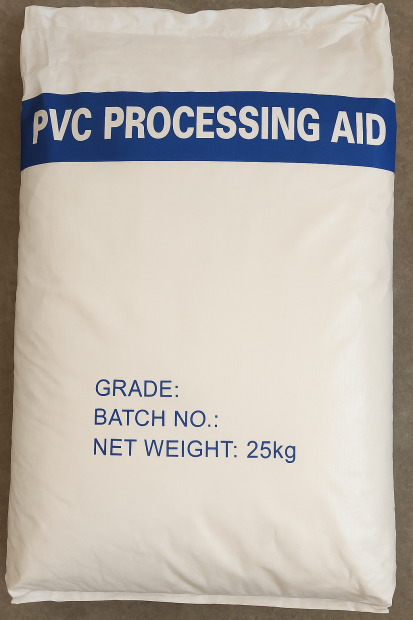
In the production of PVC products, a processing aid is a polymeric additive that regulates the processing behavior of the PVC system. The effect of a processing aid is directly reflected in parameters such as fusion behavior, melt homogeneity, rheological stability, and surface quality of the final product.
PVC does not exhibit conventional thermoplastic melting. Formation of a homogeneous melt in PVC depends on fusion and gelation under heat and shear. If this stage is not properly controlled, the PVC system becomes unstable, die pressure fluctuates, and surface defects and loss of mechanical properties occur. A processing aid controls and stabilizes this stage.
Processing aids differ functionally from other PVC additives. Internal and external lubricants control friction and release, thermal stabilizers prevent thermal degradation of PVC, and impact modifiers alter impact resistance.These additives may influence processing behavior, but they do not regulate fusion or melt rheology and therefore are not classified as processing aids
In PVC pipe and fitting extrusion, a processing aid controls fusion within limited residence time, stabilizes die pressure, and improves wall thickness uniformity. In PVC profiles, it stabilizes melt flow and improves corner filling and surface quality. In rigid PVC injection molding, a processing aid ensures the formation of a continuous melt within short residence times and improves part surface quality. In transparent PVC film and sheet, a processing aid maintains melt uniformity and prevents haze increase and optical defects. In PVC foam sheet, conventional processing aids are insufficient, and foam regulators are responsible for controlling the cellular structure.
he molecular weight of a processing aid determines its primary function. Medium molecular weight grades target fusion control, higher molecular weight grades increase melt elasticity, and very high molecular weight grades exhibit foam regulator behavior. Processing aid performance depends on the K-value of the PVC resin, and dosage cannot be directly transferred between different resin grades. In filled systems, a processing aid maintains melt homogeneity and mechanical properties. A properly selected processing aid reduces the sensitivity of the PVC system to shear rate variations and improves production line stability.
Many hidden product defects, even when surface appearance is acceptable, originate from incomplete gelation and improper selection of processing aids.
For selection of an appropriate processing aid, please contact Sepeed Polymer Afza.